Monday, 30 August 2021

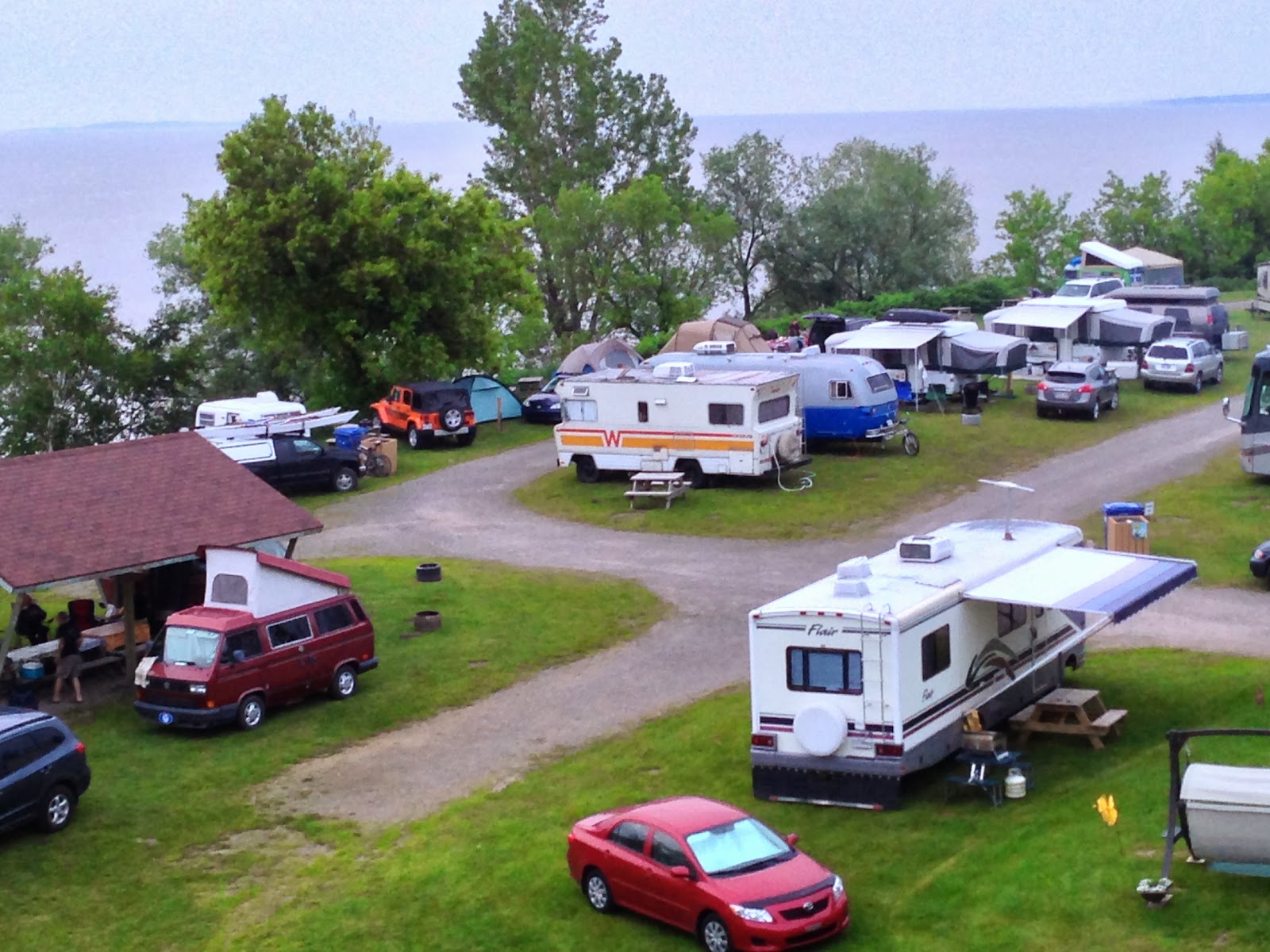
First camping trip since the pandemic!

Camping Belle Vue, Ste-Croix, Lotbinière, Quebec.


Monday, 14 October 2019

Just to show that the Blue Whale is still alive and kicking!
End of the 2019 season at Camping des Voltigeurs, Drummondville (Quebec).


Monday, 27 June 2016

New hot water heater

The Travco was without a hot water heater since the old heater was removed because it was leaking.

Quick reminder: the original water heater in this motorhome was not a propane unit.  The water was heated by the engine, via some coolant lines running all the way from the engine to the rear of the vehicle, where the hot water tank was mounted. It worked good - as long as the engine ran for a long enough time to heat the water. Parked for a few days at the same spot without running the engine meant no hot water. Not very useful...

It's not that a water heater is an absolute necessity. One can live very well without one - as long as you don't feel like taking a shower in your own shower!

Dad wanted to put in a standard, propane-heated water heater in the Blue Whale, like in any RV. The thing is, these units are quite expensive. So Dad was waiting for a good deal.

And the good deal came last summer. A friend of mine told me he'd just took the water heater out of his popup trailer. He told me he wanted to free some space in his camper, he'd never used the water heater, he didn't even know if it was working or not. I jumped on it and brought it to Dad, who tested the unit, and found it in perfect working order.

So that water heater is now installed in the Travco.
It was installed at the rear, in the same spot as the original one. It's actually under the bed area, driver side.

Since the original unit didn't use any propane, there was no exterior access door for the water heater. With the help of his friend Gerry, Dad cut an opening in the side of the Blue Whale. Also, there wasn't any LP gas line back there, so Dad had to install one. Finding the appropriate couplings and gas line proved more difficult than the installation itself.

Dad installed added a winterization kit to his water heater, which will greatly simplify the winterization process at the end of every season.

Dad repainted the exterior access door with a metallic gray spray paint.
Work is done, the unit works perfectly. A few pictures:


Tuesday, 7 July 2015

Solar power

Solar power

Late June 2015, first trip of the summer for the Blue Whale, up north to the Saguenay region, for the Bagotville International Airshow. They stayed at the St-Félix d'Otis municipal campground, just a few miles east of the military base, where they met my brother Luc & family with their popup camper, and Dad's cousin Roger in his Class B Safari Condo RV.

After the airshow, my parents drove west to the Lac St-Jean region, where they stayed for a few days and visited relatives (Lac St-Jean is Dad's birthplace).

On this trip they could test the newest addition to the Blue Whale: a nice 140W roof-top-mounted solar panel. Since the Whale is almost always used without any campground hookups, this solar panel should provide enough power for extended stays without the need to use the genset daily to recharge the battery.


One of the issue encountered when dry camping was the fridge would quit as soon as the battery voltage would drop a little. The fridge's main gas valve, 12V powered, seems somewhat sensitive to voltage drops and shut the fridge off all the time, pretty annoying. Now that solar panel keeps the battery voltage high enough that the fridge ran flawlessly for the entire week.

Also, most of the standard bulbs in the interior fixtures have now been replaced with LED lights. These lights all come from my favorite electronics and gadgets store, Deal Extreme.


Click HERE to see the exact LED bulbs used.

The solar panel provides almost as much power as the LEDs use during the evening. The battery stays mostly recharged, deep discharges are thing of the past, and this will help extend the battery's life.

The panel is glued to the rooftop on four brackets Dad made. Dad didn't want to drill a hole on the fiberglass shell to run a wire, so the panel's wiring goes down in the motorhome through a nearby roof vent, then into the small fuse compartment in the cupboard above the counter, where it is spliced in the Travco's electrical system. The panel uses a small voltage regulator (a little electronic black box) which is also housed in that fuse compartment.


What's that noise?

There was this strange noise that started on this trip, coming from the top (non, it wasn't the solar panel!). Turned out it was the air conditioner shroud that was flapping in the wind and hitting the top of the AC unit.
That shroud is in decent shape, but over time it started to sag in the middle. So once back home, Dad took the shroud off the motorhome and decided to freshen it up a bit. First the sag was cured by adding 2 small aluminium channels lengthwise, on the top. Notice how they curve a little bit in the front to match the shroud's shape.


Then some clean up, a bit of sanding, a nice coat of paint, and now it looks like new!


Gerry's lucky bad luck

Dad's best friend Gerry, who's living full time in his motorhome, has been parked at my parent's place for a few weeks. Last Sunday he decided it was time to move and pay a visit to relatives and friends in Lac St-Jean. Off he went, but after a few miles he phoned to my parents: he was coming back, his engine just blew his head gasket! Coolant was leaking out the engine, but he figured he would be able to make it back. And he managed to make it, and he was relieved he did, coolant still dripping out the engine but with the temperature still showing normal.

So, he was lucky in his bad luck. This gasket could have blown 2 hours later, where he would have been in the middle of nowhere, and it would have never been able to come back and it would have been a costly towing to get him out of there. Now at least he was at my Dad's place, probably the best place one can choose to be stranded!

Gerry will fix it himself. His Winnebago motorhome is a big Freightliner-based diesel pusher, with a Cumins engine.  There it is, parked in front of the my parent's Travco.


Gerry was a mechanic by trade, he knows these big diesel engines very well, he knows exactly what to do and how to do it. He says a head gasket job is not overly difficult, it just takes time. He figures maybe 20 hours, taking his time. Here's a picture of the engine, which is in fact under the master's bed, at the back on the vehicle:


Sunday, 7 September 2014

50th Anniversary

2014 marks the 50th weeding anniversary of my parents. For the occasion, we all went on a trip to the Caribbeans. We spent an amazing week in an all-inclusive resort, the Memories Flamenco Beach Resort, in Cayo Coco, Cuba.


Like every summer during Labor Day weekend, we went up to the Lac St-Jean area, about 300 km north of Quebec City, for our annual family gathering and corn roast. This took place at my uncle's place, in the rural town of Ste-Jeanne-d'Arc. This years again, along with some relatives, my parents drove the Travco up there and parked at my uncle's place for a few days.

This years we wanted to commemorate the 50th wedding anniversary with the family.  Mom and Dad had no idea that we were going to do anything or even mention the 50th anniversary during this weekend, since for them we had already celebrated the event in July with the trip to Cuba. But we had a few surprises in store for them...

We started at first light on saturday morning. It was like 5am, with Mom and Dad still sleeping in their motorhome, we quietly put some decorations on the Blue Whale and on the ground around it. Then we got back to bed...

When Mom and Dad woke up a few hours later, they just couldn't believe it!


On the grass in front and around the Blue Whale we planted about 25 large plastic flowers, and about 60 white balloons. The motorhome also had been decorated with white ribbons, including a big bow on the nose, with a sign that said (translated from French): "Just Married...  50 years ago!"

(As a side note, you should have seen us, me, my wife and daughter, the previous evening, blowing all those balloons while camped in our popup camper, set up only a few meters from the Blue Whale. You can only blow so many balloons in a popup, I can tell you that the camper quickly filled to the roof with balloons, they were everywhere, we literally had no place to do anything, a really funny sight! We slept among balloons that night!)

In the afternoon, as the whole family was there for the gathering, we had our second surprise for our parents: we had a ministry from the local parish who presided over a short ceremony where my parents renewed their wedding vows.

After the outdoor picnic of corn, burgers and hot-dogs, we had our last surprise: we had a big 50th anniversary cake, and a small glass of sparkling wine for everyone! Cheers!

Then we had nice fireworks, for the pleasure of everyone!

Sunday, 1 June 2014

The latest from the Blue Whale...

Yep, we're still there ! But before I go on with the Whale, a few words about its owner.

Dad injured its left knee last winter, just after the Holidays. A stupid thing, he simply missed a step going down the stairs. He didn't fall or anything, nothing broken, he just landed hard on its left leg, the kind of thing you usually forget right after. But not this time: the pain got into his knee and never left.

Went to see a doctor a few times, some bonesetter, got X-rayed, massaged, was given various medications, nothing would do. A sharp pain, that prevented him to walk and even sleep, and that only subdued - briefly - with a lot of pain killer drugs.

Normally Dad never stops. Always tinkering around the house. Just last fall, he fell 3 huge trees on his lot, pulled out the stumps, redid the landscape, cut and then carried all that wood, etc. Big big job. In his shop, he always has something going on: metal working, welding, working on the cars, etc. At 79, he's still hard to follow !

Well, not this winter. With this knee pain that prevented him to do just about anything, Dad felt like a lion in a cage. Pain, lack of sleep, strong medications, frustrations in the face of all the undone jobs around the house piling up...

Last month Dad finally had some stuff injected in his knee. Not sure what is was, but it's supposed to heal the knee and cure the pain. Well it did, but it's a slow process. Dad still feels some pain, but not as much. He doesn't take as much medications as he used to, he sleeps better, and he slowly began to tinker around the house. He now has to walk with a cane.

The return of warmer days and some ability to do things (although still limited) certainly helped boost his morale. Sometime with the help of one of his brothers, or with his good friend Gerry, Dad was able to go through most of the little springtime jobs around the house: take down the car and the Travco winter shelters, cleanup of the backyard, put the summer tires on the car, and of course de-winterinze the Blue Whale and get it ready for it's first trip of the season, possibly in mid-June.

The Whale

The Travco spent the winter in comfort, in the temporary shelter that Dad builds around it every fall. The only issue noticed this spring: the battery was completely dead. That's rather strange, since everything on the vehicle was OFF, that battery should have kept most of it's charge through winter. But this battery, a big and heavy 8D battery that's fairly recent, was never really good, with poor capacity right from the first day, according to Dad.

So the big thing was taken out of its tray and brought into Dad's shop. Then it was submitted to a "smart" charger's maintenance and desulfation cycles, then fully recharged. Not sure how really "smart" that charger is, but anyhow once stabilized the battery showed 12.7 V, which is the normal voltage of a fully charged battery, but doesn't guarantee any Amps capacity.


Today I helped Dad to put the heavy battery back in its compartment in the Travco. Boy this thing is heavy, it must weight well above 100 lbs. Then I did a few tests with the multimeter, trying to figure why the battery got discharged like that during the winter. I couldn't find anything wrong, I got a real open circuit (infinite resistance) between the battery leads of the vehicle, and I couldn't read one single milliAmp of current flowing when the battery was hooked up.


So for now Dad decided to give this battery one last chance. We'll see how it goes, if the battery doesn't deliver the juice, Dad will replace it.

Lets crank it up!

Now it was time to start, for the first time this year, the good old 440. The Travco had been sitting there since late October last year, so the engine had not run for 7 months. Dad engaged the starter for about 10 seconds (pretty good battery by the sound of it) then paused a little, while pumping the gas pedal a few times. Then he re-engaged the starter and the big V8 instantly roared to life !  You should have seen the smile on Dad's face!  No sputtering, no clicking or suspicious noises, just a smooth idle, the engine just ran like if it had just ran the night before.

I caught this first start on video:


While at it I checked on the Travco's charge system: if the battery remains suspicious, no worries about the alternator, which was putting out a healthy 14.7 volts at the battery.


Arizona

Last winter was even harder for Gerry, Dad's good old friend.

Gerry and his wife Pierrette used to be snowbirds. Every fall they left Quebec and went south to Arizona for the winter, driving down in their nice Winnebago Class A diesel pusher. However last winter Pierrette fell ill and they had to quickly fly back to Canada. Unfortunately, Pierrette passed away this last spring.

Gerry's motorhome was left behind in Arizona, and now must be driven back to Quebec. It's a long trip for a man alone. Finally, Dad will make the trip with him. Dad and Gerry will fly together next week, all the way down to Yuma AZ, then they will drive the motorhome back to Quebec City.

Both men are experienced drivers. Gerry has done the trip many times. Dad spent his life driving semi-trailer trucks, and is very excited and eager to drive the legendary American Southwest country.

Gerry and Dad are both from the same little Lac St-Jean town, and know each other since infancy.  They lost sight of each other in their early 20s, due to work.

The two friends didn't see each other for 37 years. Then Gerry retired and moved in the Quebec City area, and both friend were finally reunited. Boy did they had a lot to talk about !!  And they still do !!

A few years later, Dad, Mom, Gerry and Pierrette planned a trip to the Canadian West. Each couple had a small Class C motorhome, and that trip brought them all to way to Alaska in 2001.

I've probably written it before, but it's worth mentioning again. Gerry was a master mechanic by trade, he's in fact a extraordinary mechanic, his vast knowledge makes him and absolute reference for anything that runs an engine, and his support and advise to Dad has been of utmost importance during the restoration and repairs of the Blue Whale and Dad's previous Class C.

This 5000 km trip from Arizona to Quebec will take some time. They should be back home around mid-June. I wish them a good and safe trip!


Agrandir le plan

Sunday, 22 September 2013


Exhaust manifold (part 2)


After having replaced the right side exhaust manifold with a used one, Dad also had to work on the left side manifold. The gasket had a slight leak, and the manifold had a corner broken off. The manifold was not replaced, but Dad took it off and reinstalled it with a new gasket.


As with the right manifold, it was no easy task. One of the studs had stripped threads, the nut was completely loose and no way to tighten it. Looks like the previous owner found a "clever" way to "fix" this: drill a hole through the stud and drive a cotter pin in the hole! Of course that didn't make the nut much tighter, so Dad had to properly fix this. Here's this infamous stud, which took a lot of work to get out.


So in the end, both manifolds were taken down, one of them had to be replaced, and both gaskets were replaced as well. No more exhaust leaks and noises, and no more risks of getting stranded due to a completely blown gasket or broken manifold.


Valve seals

Another issue that Dad wanted to fix was the valve seals. These are small rubber seals that prevent engine oil from entering cylinders at the valves. Over time the rubber degrades and dries, and then oil can make its way inside the cylinder under some conditions.


Typically, this happens on a cold engine that hasn't ran for some time, where residual oil from the engine heads will slowly leak past the valves and into the cylinders. When the engines is started, the oil burns and a blueish smoke cloud comes off the exhaust pipe.


Also, if the engine runs at idle for some time, or when descending a steep downgrade with the foot off the gas pedal, high levels of vacuum at the intake manifold caused by the throttle valve being closed attracts oil in the heads around the valve stems. Upon acceleration, the oil gets sucked past the eroding seals and down through the valve guides, where it burns in the exhaust. Pressing the accelerator after a long coast will cause huge clouds of blue-white smoke exit the tailpipe. The burning smoke will disappear during cruising or highway speed.

The older the seals get, the more obvious the problem gets, oil comsumption increases, and those blue smoke clouds just make the vehicle look like an old wreck. Fortunately, this is not a very serious problem, it is not very hard or expansive to fix. However the valves have to be done one by one, wich is somewhat time consuming.

Normally a special tool is needed to compress the valve springs and remove them, but it could not be used due to the lack of space. The floor opening in the engine compartment of the Travco is right at the same level as the valves and prevented the use of the tool.


So Dad decided to make his own spring compression tool. A few hours of work, some adjustments, and the tool was ready. It allowed Dad to easily compress the valve springs and then take them off.

Here's the homemade tool. Just turn the threaded rod!


Dad used compressed air through the spark plug hole to keep the valves in position and prevent them from falling down in the cylinders while he replaced the seals. Seal were done on all 8 cylinders, and gone are the huge smoke clouds after engine starts or at the bottom of hills!


And while being there, Dad cleaned and repainted the valve covers.


Power loss


Another engine issue, this time a more serious one...

On a few occasions last summer, the motorhome experienced significant power losses. The problem seemed to get worst toward the end of the season. The issue would appear typically during a sustained climb. The engine would bog down drastically, loosing all power, and would crawl its way up the hill at a very low speed in 1st gear. Not fun at all !

This started two years ago, but last summer it got so obvious that Dad got worried and couldn't ignore it anymore.


Dad first suspected the fuel pump. He checked it, found nothing wrong with it, but decided to replace it anyway, just in case. But the problem remained. Normal driving, highway driving, was just fine, even when flooring the gas, like when passing. But during long climbs, the engine still lost power.


So Dad tought about the carburator. Maybe the choke wasn't working right, or something like that. Since until now the engine always ran just fine, Dad never actually tought about the carburator. So it could be anything, like some dirt inside the carb, a bad float, or maybe it just needed some cleaning and a readjustment.


Carbs like this are pretty complex. The carb is a Carter ThermoQuad, pretty much the standard carb found on many Dodge/Chrysler V8s of the era. Dad didn't want to touch it himself, so he started looking for a guy who knows these carbs. With today's electronic fuel injected engines, carbs are a thing a the past, and it is not easy to find a guy who knows about these 40-year old carbs. But Dad found his guy, and brought him the motorhome.


He took the carb off for a complete overhaul, and soon realised that sometthing was wrong: a part was missing !


The missing part is called a metering rod. There are 2 such rods in a ThermoQuad. They are some sort of thin needles that basically limit the fuel when the engine is under light load. Under high loads (like going uphill) the engine shouldn't be too affected by this missing part. However, it could make the air-fuel ratio too rich under light load, and affect the fuel mileage. In the end, it looks like the engine had been running without this part for some time (it was certainly missing when Dad bought the motorhome 6 years ago), and there was no clear evidence that this was causing the power loss issues.


Anyhow, Dad managed to find replacement metering rods, and his guy completely cleaned, rebuilt and readjusted the carb. New gaskets were used and the carb was put back in the Travco.


And now the engine runs perfectly. The big 440 starts nicely, idles smoothly, roars instantly at the touch of the gas pedal, and pulls the Travco up any hill for any lenght of time with power to spare !!  


Storage compartment


Meanwhile, Dad added a new storage box on the motorhome. Travco's storage compartments are not very large, and Dad was looking for more space, specifically some place to store his leveling blocks. So he decided to add a new storage box, under the rear left storage compartment.


There wasn't enough clearance for Dad to use standard hinges for the compartment's door, so he had to figure out a different way to make the door open and close and lock. Some "Whale Blue" paint, and the job was done! 


Here's the new storage box, with the door closed and open. Pictures don't show the lock details, but as usual it's a very clever design, typical of Dad !


Trips


The Blue Whale made a few trips this summer. First one was a camping weekend at the Pointe-aux-Oies campground in Momtmagny. Family and friends were on adjacent sites, as shown on the following picture where the Whale is just beside Dad's brother Yvon's 1975 Winnebago.


This summer the Blue Whale went up Quebec's north shore, all the way to Sept-Îles, QC, where my parents visisted friends and relatives.

Next was a trip in the Laurentians, north of Montreal, for a few days, then Lac St-Jean and Charlevoix in early September. This year's last trip will probably be during the canadian Thanksgiving weekend (mid-October), in the Beauce region. With this trip, the Blue Whale will have travelled over 3000 km this summer.


Thursday, 13 September 2012

Ticking noise...


tick-tick-tick...

That's the noise that the engine was making right after startup. Then the ticking went away as the engine warmed up. Dad quickly figured it out: he had a cracked exhaust manifold. Curb side manifold, large crack in the middle of it.

Last week Dad jacked the front of the motorhome, pulled the right wheel off, and got down to work. But what was supposed to be a relatively simple and straightforward job quickly turned into a nightmare...

Replacing an exhaust manifold on a 440 V8 is not very complicated. The manifold is held against the engine block by 6 studs and 6 nuts. Once the exhaust pipe and spark plugs are out of the way, the nuts are removed and the manifold can be pulled off. Then you put the new one in with a new gasket, and reassemble. Simple, isn't it?

First Dad noticed right away that someone, a previous owner maybe, had already messed with this manifold. The two center studs where way too long, protruding by about 1.5 inch over the manifold. The outer right stud wasn't even a stud... it was just a bolt, a plain, non-graded bolt. The other 3 studs looked normal.
(Sorry I don't have pictures, I'll try to have some later on).

Dad started with the bolt. Yes you guessed it, it snapped right off, with almost no effort, as soon as he put a wrench on it. It broke flush with the block... This one will have to be drilled out. Dad made himself a drilling guide to center his drill bit in the center of the stud, and managed to do an OK job at it, using his hand drill. Using a tap, he should be able to fix the threads worn by the drill bit.

Then the nuts on the 3 "normal" studs came off with no fuss.

Now the 2 center studs. It looked like the guy who put them on simply used regular threaded rod. Yep, plain 'ol threaded rod like you can buy at Home Depot. These are soft and break easily when new, can you imagine how brittle they get after years of heating/cooling/rusting ?
Now Dad had to be very careful, because cause this could have quickly turned into a big costly mess...
Instead of putting a wrench on them and risking breaking them off, he first cut the nuts off wih his small grinder and a cutting disk.
Now the manifold could be removed, so Dad was left with three good studs, one missing stud (the broken bolt one that he drilled out) and in the center those two pieces of threaded rod, sticking out by about 3 inches.


A new manifold for this engine looks like this:


Notice the holes for the outer studs (2 on each side), and 2 the recessed holes, near the center, for the 2 center studs. While standard nuts are used on all 4 outer studs, the 2 center ones require what Dodge calls "sleeve nuts", wich are long nuts that seat at the bottom of recessed recessed holes in the manifold. These "sleeve nuts" look like this:


With these special nuts, the manifold is held against the engine block but remains free to expand when hot. But it looks like the guy who once "fixed" this manifold had no clue about this. He simply used regular nuts (with washers to cover those "inconvenient" recessed holes) on his home-made, 4-inch long, threaded rod studs. This mistake in fact prevented the center part of the manifold from expanding outward as it got hot, and eventually caused the manifold to break.

For Dad, the easiest way to deal with the threaded rod studs was to let them in place and reuse them. But using regular nuts and washers on them was out of question: that would probably cause the new manifold to break again later. Using OEM "sleeve nuts", as it should be, was impossible with these home-made studs: normal studs have coarse threads into the block, and fine threads at the nut end. With their fine thread, sleeve nuts wouldn't work on the threaded rods' coarse thead.
Another option was for Dad to fabricate his own sleeve nuts, using coupling nuts. Coupling nuts are longer nuts, used to joint threaded rods and look like this:
So he bought a few of these, and figured that two of them welded together, end to end, could be used just like sleev nuts. They would seat at the botton of the recessed holes, just like the OEM sleeve nuts, and allow the manifold to expand when hot. But then Dad feared the 'studs' would break while thightening the nuts...

Another risky option was taking the chance to try to remove the home-made studs. They were rusted and well seized into the block. Many times Dad put some heat on them, hit the end with a hammer, trying to break the bond with the block, sprayed some penetrating oil, prayed a little, swore a little, tried them with the wrench but nothing moved...

I left the operation room (Dad's backyard) that afternoon with the surgeon (Dad) in a grim mood, still thinking about what he was going to try next with those stupid threaded-rod studs. It was his 4th day working on this problem.
Me, I was now on a mission to search the web and try to find him a replacement manifold at a fair price.

But good news came later that night. I relieved Dad phoned me: "You now what? I got them! I got both of them out!"
I don't know how he did it, but with great care and patience, he managed to unscrew the damn threaded rods without breaking them off. It's a bit of a miracle I'm telling you!

Now he will be able to properly reinstall a replacement manifold, with the proper studs and nuts. He's still debating between having his old manifold welded by a specialized shop or using a new (used) one. I found one up for sale on the web, and as of tonight I'm waiting for the seller to set his final price.

I asked Dad if he checked the left side manifold for cracks. I could see what was going on in his mind when he heard my question, and he just looked at me and said: "No I did not, and one thing at a time, will you!!"

Sunday, 27 May 2012

We're still here!


It's been almost two years now since I've posted anything on this blog, but we're still here!
Last summer has been a quiet one for the Blue Whale. No large restoration projects or repairs. Mom had knee surgery last spring, and Dad had some work to finish on the house. The Whale hit the road a few times during the summer, mostly towards Lac St-Jean and New-Brunswick, where our families are from.

I'm not expecting any large jobs on the Whale for this summer, in fact the main project for this season may just have been completed last week, as Dad installed a new radiator on the motorhome.

Radiator

The Whale's radiator certainly wasn't the original one. It probably has been replaced by the previous owners at least once since 1975. It had been leaking for some time, Dad knew about it. The time had come to fix this before ending up with bigger troubles along the road.

Getting the old rad out wasn't as easy as it looked. The rad is held to the frame by 2 metal brackets. Once the coolant was drained, hoses and a few bolts removed, theoritically the rad was free to come out. But it wouldn't bulge, still held by the metal brackets, from wich it was supposed to slide out. Dad finally had to unbolt the brackets themselves, and the whole thing finally came out.
Of course, there isn't much space to work in the nose of a Travco. And the last days were very hot, so Dad attached a tarp in front of the Whale to provide some shade.


Following the advise of his cousin, a master-mechanic, Dad went to a local shop named Radiateurs ACME to have his rad reconditioned. Only the top and bottom part of the rad are reused, and the center core is brand new. The result is a virtually new radiator for a 37 year-old vehicle, they really did a great job.


The radiator came back from the shop with the 2 brackets still attached. Looks like they couldn't take them off either. For some reason they are probably welded to the rad.
Dad's cousin is a good customer at this shop, and this allowed Dad to get a nice discount on his bill!
So a great job and a good price too!

Before putting the rad back in, Dad cleaned and repainted some of the accessories in front of the big 440, in Mopar Blue, of course! New belts were put in, and a new lower radiator hose too (the other hoses were all in good shape).


If you remember my post about the water heater, you may remember that the Travco's water heater was heated by engine coolant. Long coolant hoses are running from the engine all the way to the rear of the motorhome, where the water heater used to be. Since the water heater was taken off the Whale because it was leaking, and since the replacement water heater will probably not use hot engine coolant to work, Dad unplugged those long coolant lines from the rest of the cooling system. (hopefully one of my future posts will be about a new water heater installation, stay tuned!) 

It was the right time also for regreasing the front end components as well.


A quick spray of black paint on top of the front bumper before putting the front grille back on.


I'd like to draw your attention to the photo above. On top left of the radiator is a plastic bag hanging. This is actually the washer fluid reservoir! It may seems strange today, but back in the 60s and 70s, rigid plastic tanks for washer fluid were not that common. This type of soft reservoir, wich reminds me of an IV bag, was fairly common. And this is the original pouch, still leak free and with soft, flexible plastic.
Now if you look on the right side of the rad, there is a hard plastic tank, wich is the coolant overflow tank. Now this one Dad had to almost entirely rebuilt with fiberglass, since the plastic was cracked and very britle. So it looks like the soft pouch-type reservoir wasn't a bad design after all!

In the end the cooling system was refilled, the engine ran up to operating temperature, and then Dan made sure there wasn't any leaks.
All was good, so one more solved issue with the Blue Whale, and above all, one less concerned vacationer on the road!

Sunday, 29 August 2010

Magazine star!

Wherever it goes, the Blue Whale doesn't go unnoticed. I guess this blog helps somewhat: last May I was contacted via the french side of this blog by a journalist from the french-language Camping Caravaning magazine, published by Féderation Québécoise de Camping et Caravaning (FQCC - Quebec's campers and RVers federation, the largest campers and RVers association in Canada) who wanted to write an article about the "2nd life of RVs". I quickly put her in touch with Dad, a phone interview followed, and I sent a few pictures of the Blue Whale.

Once again, Dad was astonished by the interest for his works on his old motorhome. I was surprised too, since Dad is not even an FQCC member, but I was also proud of the recognition it brought on all the work he put into the Travco, and I knew Dad would be more than happy to chat with the lady about his old motorhome.

So we patiently waited til the August 2010 issue came out. And there it was, on page 73, an very well written article on Dad and the Blue Whale. Under the title "Second début pour un vieux VR" ("Second start for an old RV") the article tells the story of when Dad bought the Travco, all the work he put in it, there's a picture of the motorhome and the ULR of the blog.


Dad was glad, but he's kind of used to it now: this was not his first time in a magazine. Two years ago my younger brother wrote an article about Dad, for the Motoneige Quebec magazine, a french-language Snowmobile magazine. A long time snowmobiler, Dad had actually built his own snow machine back in the late 50's. My brother - a hardcore snowmobiler himself - tought this was no ordinary story, and he wrote the article, without telling Dad about it. His text was published in the January-February 2009 issue of the magazine. Dad was surprised to say the least, but then truly touched, as this came from his son.

Anyway... quite a few people since has met my parents, saying they saw the Blue Whale in the FQCC magazine, and a few left comments in the blog, which is always appreciated. Tnanks to all.

Summer vacations

This year's travel plans have been delayed a bit, Mom's health having played a few tricks on her. Once she felt better, the Whale left Quebec City, travelled in the Gaspé and northern New-Brunswick area for about 10 days. Nice relaxing vacations, not a single issue with the Travco on this 2000 km trip, and the Whale is always a favorite among other RVs.
The Blue Whale is back on the road as I write this, heading for Charlevoix and Lac St-Jean for another 10 days or so.


Carl

Friday, 16 July 2010

Summer 2010

About time for an update, isn't it?

We're already mid-July, and of course Dad has spent some time working around his motorhome.

Oil leak
There was a leaky oil seal on the Whale's engine. Nothing to worry about, however when Dad was visiting relatives or friends and parking the Travco in their driveway, he always had to slip a piece of cardboard under the vehicle to avoid oily stains on the ground. People already figure that a 35 year old motorhome must be an old leaky clunker, Dad thought lets not prove it to them, and replace that seal!

Simple enough, right?
Well, not quite...

First drain the oil, then remove the oil pan. Might as well clean it up and repaint it.


Then the seal itself.
It a two part seal that goes around the engine crankshaft. Being two parts means the seal can be replaced without having to drop the crankshaft.
The bottom half of the seal was easily removed once the oil pan removed. However, the upper half didn't cooperate as much.
Picture of the engine, oil pan removed:


Closeup of where the seal goes (where it's blue):


The seal is not rubber, it's made of some sort of braided fibers, somewhat like a rope or cable. The instructions to get it out are pretty simple: just thread an appropriate wood screw into the end of the seal, pull on the screw to take the seal off. Very simple, but it never worked. There was no way that a simple wood screw, no matter what size was tried, was going to hold strongly enough to that seal.

So Dad tried to remove it by pushing it around the crank. Using a small hammer and a brass rod, Dad hoped to get it out by pushing on one end so it would come out on the other side. The seal did slide slowly around, but the fibers got compressed and the more Dad pushed the tighter the seal was wedged against the crank. Dad finally got it out this way, but it took a long time, different pieces of curved brass rods in different lenghts to hammer the seal out.

Picture of the seal, the metal bracket that holds it, with the new replacement seal, made of rubber. The manual is the Haynes book for Dad's 1981 Dodge Ram van, showing the seal replacement procedure. The Travco's drivetrain is very similar to the van's.


Reinstalling the new seal was straightforward and caused no problems.
So no more cardboard under the Travco!

Dad also works on a few other items. I'll write about that later. This year's project is a good tune up of the genset, and cleanup of the genset compartment. However, Dad had other toys to play with last spring, as he finally bought his first ATV. He spent some time working on the ATV and building a trailer for it, then he went north to his cabin to try it out.

Again this year at the end of June we had our family camping weekend in Stoneham. The Blue Whale, the only Travco on the campground as usual, had a site in full view of anyone around. Some campers actually went to my parents and told them they had the nicest motorhome of the entire campground! Looking at the bunch of big shiny expensive rigs we had as neighbors, I'm not sure if they were serious or not, but in any case the Blue Whale is certainly noticed!

Save a Winnie

My uncle, Dad's brother, was supposed to camp with us in Stoneham, but his 1975 Winnebago broke down a few kilometers before the campground, engine problems. Once the Whale was back home, Dad and Uncle got the Winnie towed at Dad's home. Then they started to work on it. News were not good. It was an old tired engine, that had been rebuilt in the past, a botched job mostly. The head gaskets were blown, the resulting pressure increase in the cooling system made a coolant hose come off, then the engine overheated. Not nice.

The easiest solution was to replace the engine. Now comes the most incredible part: we were not able to find a good used engine!
Around here we have a very large car recycler, one of the largest in Canada if not in North America, Pintendre Auto. The engine we were looking for is a 318, one of the most common V8 engine ever produced. The car recycler probably has dozens of good used 318s, but when you cal them up the first thing they ask is the vehicle make and model. "1975 Winnebago" not being on their computerized list, they can't go any further, and they can't search any part if you don't provide them first the make and model, because that's how their computer system works. Totally stupid if you ask me, you can't just ask for "a 318 engine, anyone will do, from any vehicle between 1970 to 1985, they are all the same", it just doesn't work that way.
Totally ridiculous, but that's how they do business, and they missed a chance to sell an engine on that morning.

So plan B was to rebuilt the old engine. They bought new pistons, sleeves, bearings, gaskets, etc and did it. Took them over a week, they did it with the engine in the motorhome, during a hot and humid 30 degrees C + heat wave.
Meanwhile, the Whale was quietly sitting in the driveway behind the Winnie, waiting for Dad to start working on the genset. Not sure if he's going to start that job before their vacation trip. Mom was not feeling too good lately, so they may delay their trip for some time. We'll see!

Thursday, 12 November 2009

End of the season

Here are the last few additions to the Travco that Dad worked on lately. They really are add-ons, rather than repairs or restoration projects.

Seat belts

Dad replaced the old style 2-point seat belt with a modern 3-point belt on the passenger side. The driver side will also be converter to a 3-point belt later. Those "new" belts came with the "new" seats bought 2 years ago to replace to old original Travco seats. They are from a Dodge minivan. The motorhome only had lap belts, so Dad had to find some place on the side wall to anchor the shoulder belt.

Easier said than done. Dad didn't want the bolt to be only held by the fiberglass. The achor would rip off in an accident. There was a steel beam under the fiberglass at the right place, but then there was no way to pass a bolt through it. In the end, Dad drilled a hole through the entire wall and passed the bolt from the outside. Very strong attachement, and the head of the bolt is not too visible from the outside.


Water pressure tank

Dad installed a small water pressure tank on the plumbing system of the motorhome. What this tank does is store a small amount of water under pressure, so the water pump doesn't have to start everytime water is used, and the water pressure is more stable.

Sewer hose storage

Dad was looking for a convenient way to store the sewer hose. So he made this metal storage tube, installed under the Travco just in front of the black water tank. But this is no ordinary storage tube, it's got pretty unique features (remember: you saw it here first!).


The storage tube is mounted on a slide that allows the tube to recess under the Whale, where it is barely visible and is well protected. The metal slide, in fact an old car seat track, has the inside end mounted on a swivel, that allows the storage tube to raise up once it is pushed inward, in the traveling position. A big spring holds the tube in that upward position. To get the sewer hose, all is required is to pull downward and then outward on the storage tube, wich will smoothly slide out.
View from under the motorhome, storage tube extended, then in travel position:


The hinged lid is made from an old plastic hubcap (still shows Nissan on it!).

Traveling position:


Backup lights

Nothing worst than having to backup the Whale on a campsite at night. Rear view is quite limited, one can hardly see around during daylight. So Dad installed two large and powerful backup lights, mounted on each side of the Travco. They are actually headlights, so they are very bright, and not to be used like ordinary backup lights: they have their own switch and wiring and they don't come on when reverse is selected.

In order to provide the best possible lighting while backing up, Dad installed the lights on each side of the motorhome, just behind the front wheels. And since they will not be used very often, and to protect them from damage when not is use, the lights are retractable, Dad mounted them on metal slides. The lights can be extended when required, and then retracted when not in use or when travelling. Dad put a nice plastic handle on each light. The slides are made from old car seat tracks. Strong, and works pretty good.


Dad always get out the vehicle anyway to inspect the area before backing up in a tight, dark spot. A simple pull on the backup lights handles while he's out there, and he's ready to backup safely. When retracted, the lights are almost invisible.

Curb side (on the photos the retractable step is extended and interferes, but when retracted the light is not blocked):


End of the season

As you've noticed, the Whale is parked on a blue tarp, resting on wood blocks. This means the end of the season up here. Dad has started to winterize the Travco. The last trip was in mid-October, under a dull gray sky and a cold mix of rain and snow...
So this will be my last message for this year, and although we'll keep reading your comments, the Blue Whale blog will also enter hibernation until next spring.


Thanks you and see you soon!